

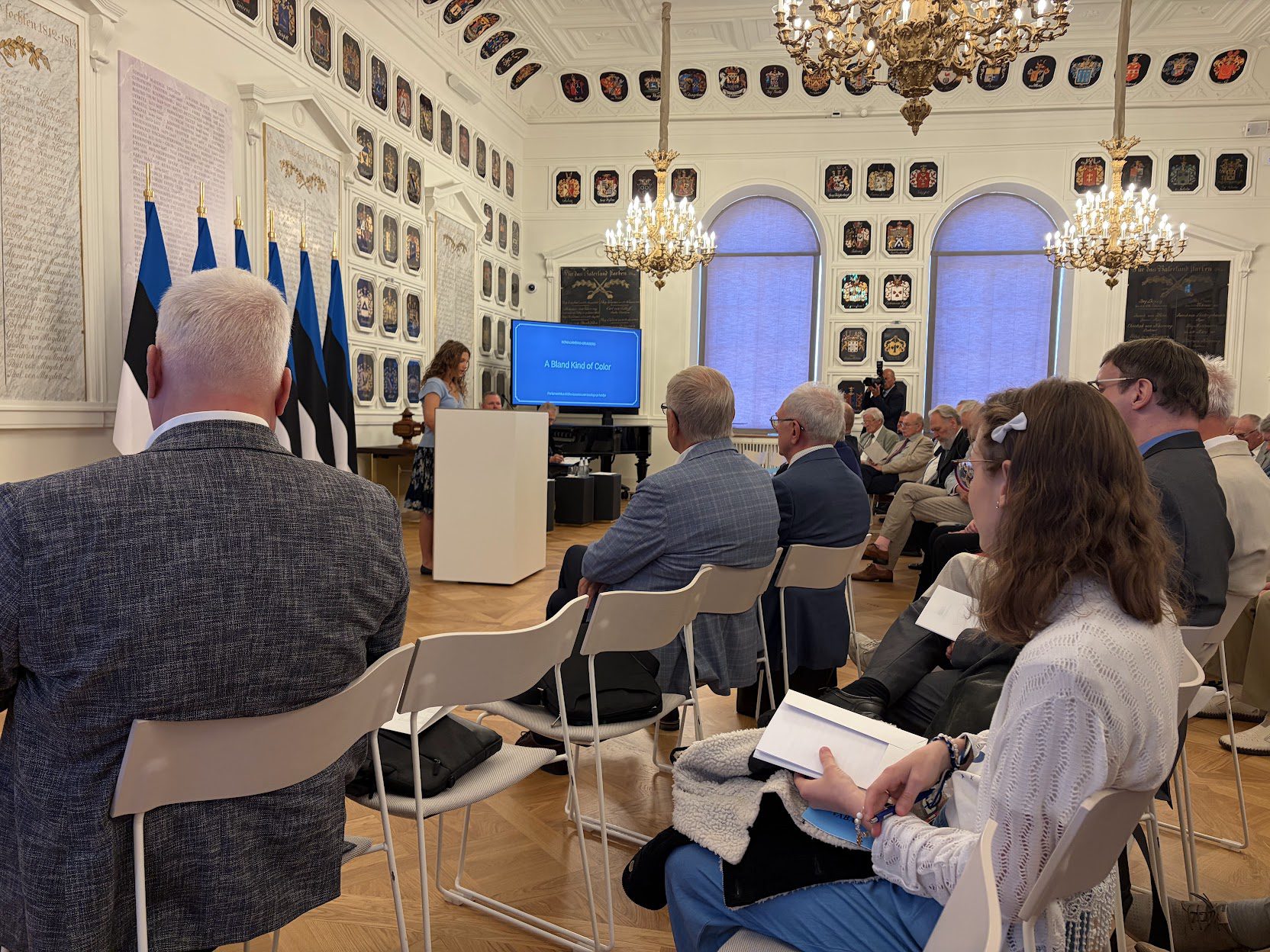
This spring Noorte Vabamu invited youth between ages 15-25 to take part in a writing competition on the theme “My Estonia”. 21 works in the form of novella, fiction, essay or poetry were submitted and out of these works the jury chose five pieces in Estonian (that can be read here) and two in English.
The winner of the writing competition, Nova Lambing-Grunberg from the state of New York in USA, got an opportunity to present her work at the Estonian Knighthood House on Toompea during the conference “Parliament as the Keeper of the Independence” on August 19th 2026. Nova’s travel costs to Estonia were covered by the Estonian Foreign Ministry.
A Bland Kind of Color
Nova Lambing-Grunberg
Age: 17
The potatoes collapsed under the weight of a fork, their skins slipping away like thin paper,
steam blurring the kitchen window in soft gray spirals. Beside them sat a loaf of rye bread,
dense and dark, a small country compressed into crust. On the table, a bowl of pickled
beets gleamed, a sharp, living red among the browns and grays. This was the food of my
childhood: heavy, quiet, unadorned. I thought it was something to apologize for. While my
friends ate dinners bright with sauce and spice, ours seemed stuck in another century.
Estonia’s food was simple, my mother told me, because it had to be. It was never meant to
impress; it was meant to endure.
I used to think endurance was a dull word. But now I know there’s a kind of beauty in it,
poetry inside the plainness. The foods of my childhood, the potato, rye bread, and pickled
beets, are more than what they appear to be. They are small testaments to survival, to a
country that learned to make meaning out of scarcity, and to a people who found
nourishment in the act of holding on.
The potato, for instance, is a quiet kind of miracle. It grows where little else will, through
cold soil, gray skies, and thin hope. My mother boiled them until they fell apart, their flesh
breaking open to reveal a steam that smelled faintly of salt and earth. I thought they were
bland. She thought they were home. During the Soviet occupation, when food lines
stretched down streets and stores stood half-empty, the potato became less a food than a
lifeline. Each one pulled from the ground was a promise that we could make it through
another winter. It didn’t need to be beautiful, it needed to be enough.
As a child, I didn’t understand the reverence. I wanted flavor, not function. But now, when I
taste a boiled potato, I understand why my mother smiled as she salted it. The simplicity
was its strength. It was what sustained her when the world felt uncertain. It was the food of
people who survived not by feasting, but by refusing to disappear. In that way, it reminds
me of Amy Tan’s “Fish Cheeks,” where she describes her childhood shame over her family’s
Chinese food and the wish to appear “American.” Like Tan, I used to feel embarrassed by
the food that represented who I was, not realizing that the flavors I dismissed were carrying
my family’s story forward.
If the potato represents sustenance, rye bread is the foundation. Thick, dark, and faintly
bitter, it tastes like the soil itself, dense with history. My grandmother baked it by instinct,
no measuring cups or written recipe. Her hands moved from habit; a technique learned
long before I was born. When the oven opened, the smell filled the kitchen, and for a
moment, even the walls seemed to exhale. I hated that smell when I was young, it made
the house feel too small, too old. But that smell is what anchored us.
According to Visit Estonia, dark rye bread, known as must leib, is “an essential part of
Estonian cuisine and a symbol of cultural identity,” something that links generations
through shared history (“Estonia’s National Bread”). It’s the kind of bread that outlasts
famine, that doesn’t crumble easily, that insists on being chewed. I’ve come to see that the
bread’s heaviness mirrors the people who make it: resilient, unshowy, stubborn in their
survival. When I eat it now, it tastes like memory, like a language I can’t quite speak but still
understand.
The beets were always the outliers, bright and loud, the single flash of color in a meal
otherwise muted. Their juice bled into everything, staining the plate red, as if reminding us
that even survival has its small rebellions. Pickling was our way of keeping summer alive
through months of darkness. My grandmother lined jars of beets and cabbage along a cold
basement shelf, their glass bodies glowing faintly like captured sunlight. She would call it
“Kindlustus talve vastu” (“insurance against the winter”) but I think it was more than that. It
was a way of preserving joy, a bright, defiant memory bottled against scarcity.
Even now, that vinegar scent brings me back. It burns the nose, wakes the mouth, and
refuses to let you forget its sharpness. When I eat pickled beets, I taste something both
fragile and fierce. As chef Jenny Dorsey argues in her TEDx Talk “How Food Can Be a Source
of Intimacy, Identity, and Vulnerability,” “what we eat, how we eat, and where we eat
fundamentally shapes our identity”. I didn’t understand that until I realized that every
Estonian meal was an act of remembrance, even the simplest of foods can hold centuries.
I think often about that idea of food as identity. In his TEDx talk “Food: A Third Culture Kid’s
Sense of Identity,” Eric Pak reflects on how “the taste of home never really leaves you,” no
matter where you go. His words echo in me. When I avoided my family’s food, I wasn’t just
rejecting its flavors, I was pushing away the history it represented. I didn’t want to taste
struggle, or scarcity, or the weight of what came before me. But in doing so, I also pushed
away the strength that came with it. Relearning those tastes has become a kind of
reclamation, a way to inherit endurance without shame.
There’s a quiet dignity in food that doesn’t try to impress. The potato, the rye bread, the
pickled beet, each carries a story of persistence. They are not elegant, but they are honest.
They taste of soil and vinegar and smoke, of effort and patience. For my ancestors, food
wasn’t about art; it was about survival. And yet, I’ve come to see that survival itself is a kind
of art—the art of making something out of nothing and calling it enough.
Now, when I sit down to eat, I think of my grandmother’s hands, red from beet juice,
pressing dough into a pan. I think of my mother, humming quietly as she peeled potatoes,
steam clouding her glasses. I think of how our meals always ended in silence, not because
there was nothing to say, but because the food had already spoken.
When I think about the future, about the life I’m still shaping beyond these kitchens and
these recipes, I imagine carrying these flavors with me. Maybe I won’t live in Estonia, or
even speak the language fluently, but the food will follow me wherever I go. They will remind
me that stories can be boiled, baked, or pickled and still last for generations.
Maybe that’s what food really is: a translation of history into the language of the body.
When I taste these same flavors now, the earthy calm of potatoes, the bitter grounding of
rye, the bright sting of beets—I taste more than ingredients. I taste resilience disguised as
simplicity, the quiet strength of a people who built meaning from the barest materials. To
eat what they ate is to understand them. It’s to taste the hands that planted, peeled, and
preserved so that I could live in color again. Maybe survival isn’t just something we do, it’s
something we pass on. And if the foods of my childhood have taught me anything, it’s that
even the plainest meal can tell a story worth savoring.
Atlantic to the Baltic
I grew up learning my name in two tongues,
in my own little Estonia with tropical weather.
Remembering the birch trees I saw when I was young,
in a place far yet close to home.
I wished to experience that forever.
Walking those cobblestone streets,
old houses told me quiet secrets,
and I felt the pull of something I never knew —
some roots grow deeper than the ground beneath you.
I never lived the frost,
or the white winter.
But the Estonia in me was never lost;
for even after the dark cold,
the cornflower blooms bold
and sprinkles blue to the north.
And hope grows within those who dare to cross
from the Baltic to the Atlantic,
Atlantic to the Baltic.
— Giovanna Korst
Jury:
Liina Viies, Adviser for the Diaspora at the Estonian Ministry of Foreign Affairs
Piret Noorhani, Chief Archivist at VEMU Estonian Museum Canada
Marin Laak, Senior Researcher, Estonian Literary Museum
Iivi Zajedova, Tammepuu Klubi
Ants Veetõusme, 20. Augusti klubi
Maja Soomägi, Vabamu Museum of Occupations and Freedom