

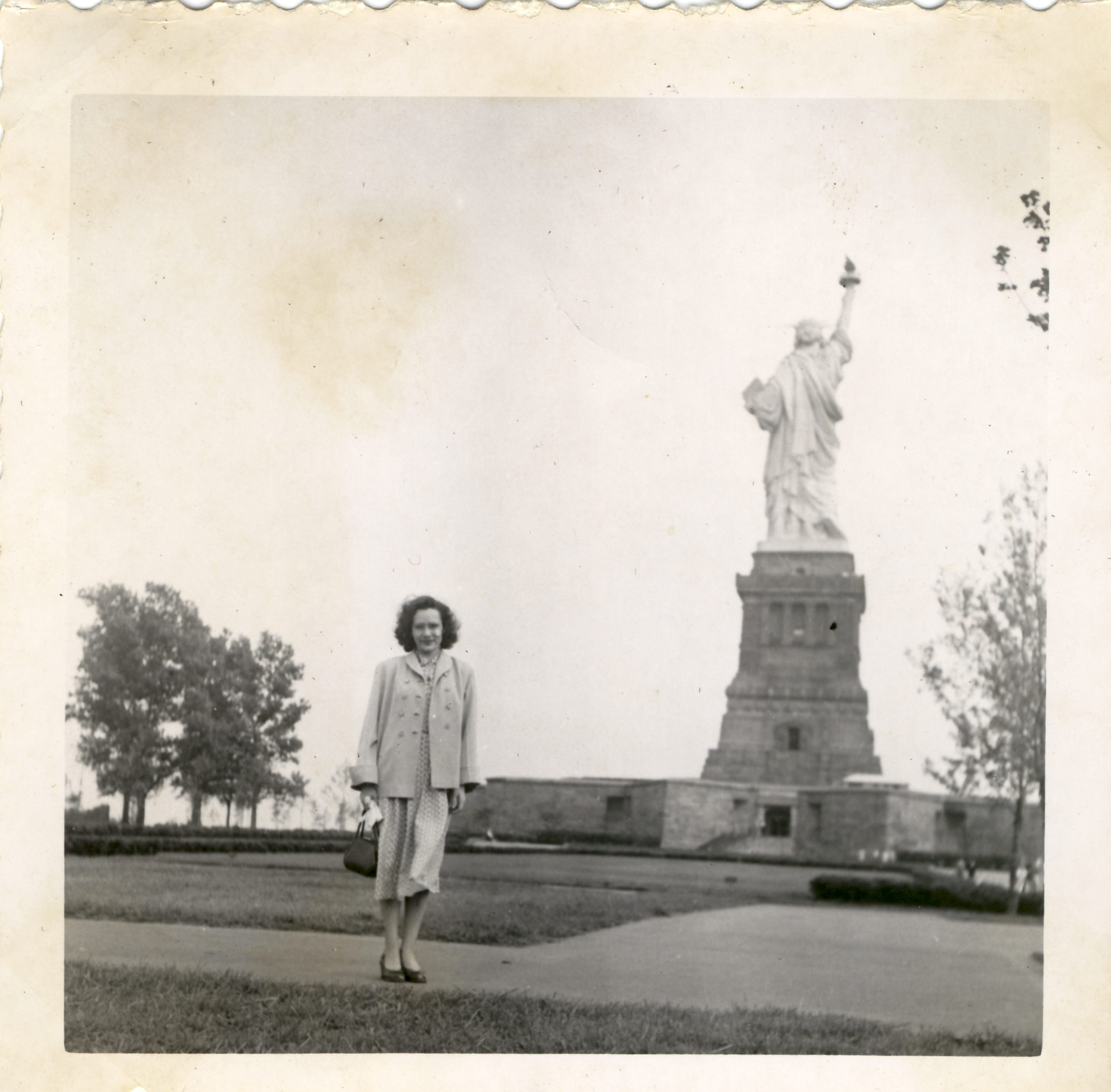
The life of Vabamu’s founder Olga Kistler-Ritso (1918–2013), is a vivid example of how sometimes some of the strongest patriots are those forced by fate to live far away from their homeland.
In Estonian media, Olga has been called a “naïve expatriate widow”, and her remarkable generosity has even inspired characters in works of fiction. Yet the sum she donated – likely the largest ever given by a private individual in Estonia – made it possible to build of a museum that has since been visited by hundreds of thousands interested in Estonian history.
“Mrs. Ritso did not flee Estonia with a suitcase full of gold, but left with the knowledge she had gained at the University of Tartu and expanded in a refugee camp in Germany,” remarked President Lennart Meri at the opening of the Vabamu Museum in 2003. In reality, Olga’s story is even more complex and extraordinary, though in the context of her time, far from unique.
Where is home? What is a home?

Olga Ritso was born on June 26th 1920 in Kyiv, Ukraine – at the time a battleground in the war between Soviet Russia and Poland. Her father, Eduard Ritso, was born into a farming family in Viljandi County, later studying medicine at the University of Riga. As a frontline doctor during the First World War he had served in some of the most remote corners of Russia. In 1913, he married Olga Elita von Wolski in St Petersburg, the daughter of a major general in Tsarist army and eight years his senior. While their marriage was initially frowned upon in society for their differences in social standing and age, just seven years later society had shifted to the opposite extreme: the Russian Empire had become the Soviet Union, which celebrated proletarian power, and Olga’s aristocrat grandparents died of starvation in St Petersburg.
When Olga was barely a year old, Eduard decided to move the family to Estonia. Before they could set out, they spent some time living in Moscow, their first home being a railway carriage. In a tragic twist of fate, they never made it to Estonia. In 1922, Olga’s mother died of influenza while Eduard was working at a local hospital. Only weeks later, Eduard was arrested by the Bolsheviks on suspicion of collaborating with Estonian nationalists and was sentenced to ten years in a Siberian prison camp.

“And so, at the age of six years and nine months, I remained in our Moscow apartment with my two year old sister, under the care of a nanny and – because we were foreigners – under the watch of a Chekist supervisor,” Olga’s brother Aadu later wrote in his handwritten memoirs. “We were largely left to ourselves. We were often hungry. From the pond in Sokolniki Park, across from our house, I tried to catch fish with my underpants. Once, while chasing after airplanes, I cut my leg on the edge of a sheet of metal.”
Eventually, their uncle Juhan located the children and sent them by train to Estonia. When the siblings arrived at their father’s birthplace in Viljandi County, they were malnourished, their hair was infested with lice, and their clothes with fleas. Two year old Olga’s vocabulary consisted entirely of the Russian phrase: “Raw potatoes, please!”
Living with their widowed step-grandmother Reeda, Olga and Aadu learned Estonian. But running a farm while raising two small children proved too much for her, and it was decided to place Olga with a foster family. The Ollik family, intellectuals who had recently lost a daughter of the same age, quickly embraced Olga as their own. She went on to excel at Tallinn Girls’ Primary School and later Tallinn Girls’ Secondary School. Following her biological father Eduard’s example, she chose to study medicine at the University of Tartu.
Fleeing Estonia and a new life abroad

Olga had been studying in Tartu for barely a year when the Second World War began. Estonia was first annexed by the Soviet Union, then occupied by Nazi Germany. Despite the constant fear of repression, she managed to complete her medical degree and begin her residency as an ophthalmologist (i.e an eye doctor).
By 1944, it was clear that Germany was losing the war and that Estonia would again fall under Soviet control. Relatives, especially her father Eduard, who had by then returned from a Siberian prison camp, urged her to flee. Using the identity papers of a friend’s sister, she secured passage on one of the last German military ships to leave Tallinn, narrowly escaping Soviet air raids. The ship ahead of hers, the Moero, was bombed and sunk, taking with it around 3,000 wounded German soldiers and Estonian refugees.
Olga found herself in a displaced persons camp in Erlangen, Germany, where she was able to continue her ophthalmology studies and work at the local university hospital. Although the Second World War ended in 1945, the Cold War soon began. Living in American-occupied West Germany, Olga realised she couldn’t return to her homeland, now sealed behind the Iron Curtain. Like hundreds of thousands of other European refugees, she eventually made her way to the East Coast of the United States in 1949.

Arriving in Buffalo, Olga had to start her studies all over again to qualify for a licence to practise medicine in New York State. She obtained it in 1954 and joined the private practice of Dr Elisabeth Olmstead, then the only all-female ophthalmology clinic in the entire state. Olga quickly became a sought after eye surgeon, yet as a woman she faced social double standards. At one local club-restaurant, for example, she was required to enter through the kitchen for a business meeting since its front door was reserved for male patrons only.
Olga met her future husband, Walter Kistler, through her work, as their offices were in the same building. Walter, a Swiss-born engineer who had also recently emigrated to the United States, held patents for several precision measuring instruments later used in the U.S. space programme. The couple married in 1960 and at the age of 42, Olga gave birth to their only child, a daughter named Sylvia.
“After I was born, she continued working two days a week in her practice, volunteered every other week at a free eye clinic, and devoted the rest of her time to being my mother,” recalls Sylvia Kistler Thompson. “She divided her passion and energy between two roles – doctor/surgeon and woman/mother – and managed that balance beautifully. She never worried about the little things that were expected of the so-called ‘ideal housewife’ at the time.” Defying the rigid gender stereotypes of 1960s America, Olga embodied a thoroughly modern career woman, successfully combining professional achievement with having a family.
For Estonia
In 1970, Walter’s company moved its headquarters to Seattle on the West Coast. Under U.S. law, Olga would have had to complete courses and pass examinations for the fourth time in order to practise medicine in a new state. At the age of 50, she chose to retire from her successful career and became a full-time homemaker in Washington State. Olga did not confine herself to domestic life. She became active in the local Estonian community, attending and supporting events. In a twist of fate, she reconnected here with Enid Vercamer, with whom she had once worked with at the Tartu Eye Clinic and later shared the same ship when fleeing Estonia.
Olga and Enid, a public health officer, became lifelong friends. They never missed a new production at the Seattle Opera and maintained close ties with each other’s families. “We spent a great deal of time with the Kistlers and always attended the annual banquet for Walter’s Foundation for the Future,” wrote Enid at the age of 92, shortly before her death in 2020. Walter had founded the charitable organisation in 1996, awarding an annual $100,000 prize to a distinguished scientist in the field of natural sciences and technology. In 2009, the award went to a distinguished paleogeneticist Svante Pääbo, who is also of Estonian heritage.

This, in turn, led Olga to consider how she herself might support a meaningful initiative in Estonia. “My mother valued freedom above all else and worried greatly about its loss. She read (Estonian) newspapers every day and followed the news religiously. She knew very well that powerful state apparatus that can give you everything one day can just as easily take it away the next. That is where the idea for the Museum of Occupations was born,” recalled her daughter, Sylvia.
In 1998, Olga donated three million dollars to the newly established Kistler Ritso Foundation, funding the construction of the museum building and supporting the collection of exhibits and research on recent history. Fifteen years after the opening, the foundation invested a further 600,000 euros in renewing the museum’s permanent exhibition.
Olga attended the opening of the Vabamu Museum of Occupations in June 2003 with her entire family. Cutting through a strand of barbed wire, she expressed her hope that the museum would remind future generations of the mistakes made in the past, so they would never be repeated. She visited Estonia for the last time in 2005, taking genuine joy in the positive changes she saw in society.
In recognition of her contributions, the Republic of Estonia awarded her the Order of the Red Cross, 2nd Class, and named her an Honorary Citizen of Tallinn. Olga passed away at the age of 93 at her home in Seattle, surrounded by her loved ones.
Vabamu continues to carry forward her wish to contribute to Estonian culture and to be a leader in civic life.
This text was first initially published in Eesti Päevaleht on 26 June 2020, marking the 100th anniversary of Olga Kistler-Ritso’s birth.