


Whether you need this for a school assignment, or just want to impress your friends or parents with your analytical skills – here is a simple and systematic method of interpretation.
Why analyse political cartoons?
- Political cartoons reflect public reactions to events. Studying them can help identify certain political views present in society.
- Cartoons use various stereotypes. By analysing them, we can understand how the media influences public opinion.
- It develops critical thinking skills. You get to practice finding hidden messages and distinguishing facts from opinions. You’ll also learn more about how humour is used in political discourse.
- Cartoons have their own artistic aesthetic. By analysing this, you can better understand which artistic methods are used to create humour and satire.
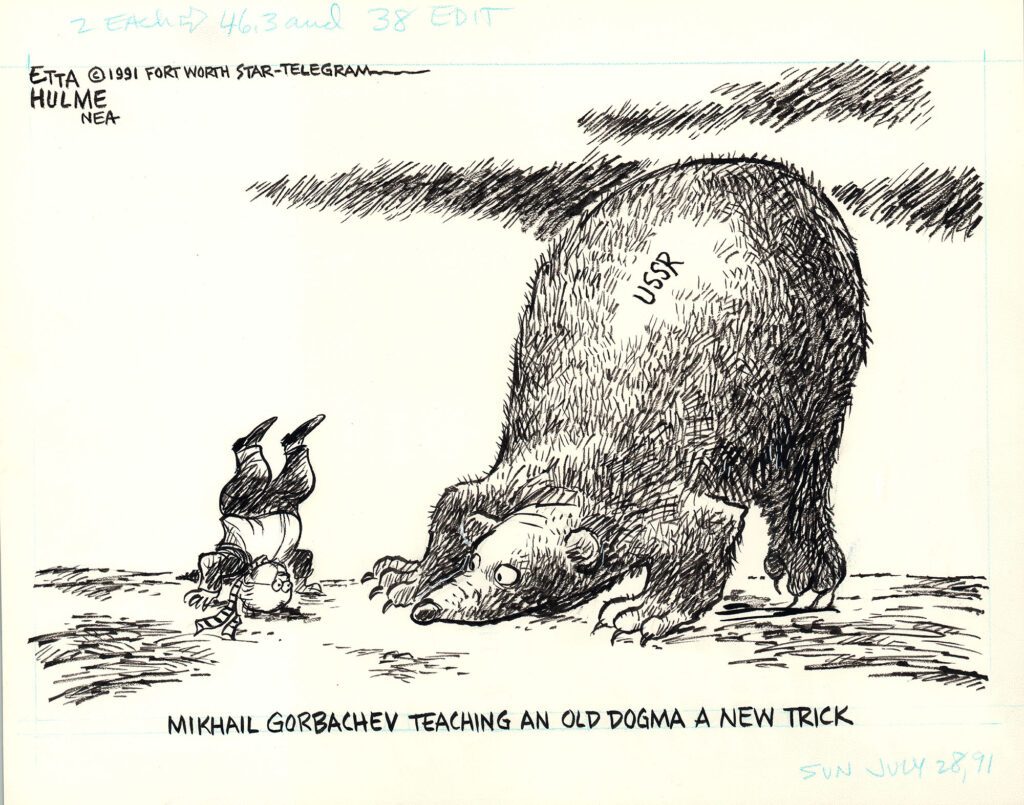
How to analyse political cartoons?
- Visual assessment. Analyse the characters in the caricature. What humorous elements does the author use? Describe the form (a standard drawing, realistic illustration, comic strip, animation frame, or something else).
- Content. What viewpoint does it represent? What is the plot or scenario? What artistic methods are used (hyperbole, pun, sarcasm, etc)?
- Historical or media context. What political or social events might have influenced the creation of the caricature? Which media outlets distributed it? Are there references to other cultural phenomenons or political texts?
- Impact on the audience. Who is the target audience? What emotions or reactions might it provoke (laughter, smirk, irritation, or a call to action)? Does the cartoon create new meanings or reinforce already existing stereotypes?
- Critical analysis. How objective or impartial is the caricature? Are its claims based on facts? Which opposite viewpoint could you make a case for?
Cartoons that kill
On 7 January 2015, the French satirical weekly Charlie Hebdo became the first target in a deadly series of terrorist attacks. This documentary pays tribute to the victims and examines the impact the events had on France and the world.
Power fears ridicule
An animated documentary about the life of cartoonist Gori, whose career in early 20th-century Estonia reflects the delicate balance between power and freedom. In Gori’s (1894–1944) Fellini-esque world, political intrigue mingles with theatrical absurdity. No subject was beyond the reach of his sharp pencil-until the political climate shifted and censorship silenced voices. The new dictators feared nothing more than being laughed at, even as they used ridicule to attack their own enemies. Raimo Jõerand’s Gorikaturist traces both the lure of squandering one’s talent in exchange for public applause, and the obligation to remain true to that talent, even when doing so leads to personal ruin.
From the Vabamu collections
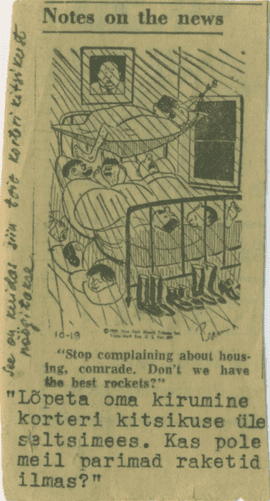
A newspaper clipping of a cartoon, sent to Maret Kärtna from Canada in 1964–68? Uncle Paul wrote to the Kents in Canada that they were living comfortably; in a two bedroom apartment, the larger being their family’s (him, his wife, 3 year old daughter, 1 year old son), with a kitchen, bathroom, toilet and hallway, to be used in turns with the family living in the smaller room (3 people). The clipping has an Estonian translation printed on it. The cartoon depicts the poor housing conditions in the USSR.