


1989 was the year of great changes, not just in Estonia, but all over Europe.
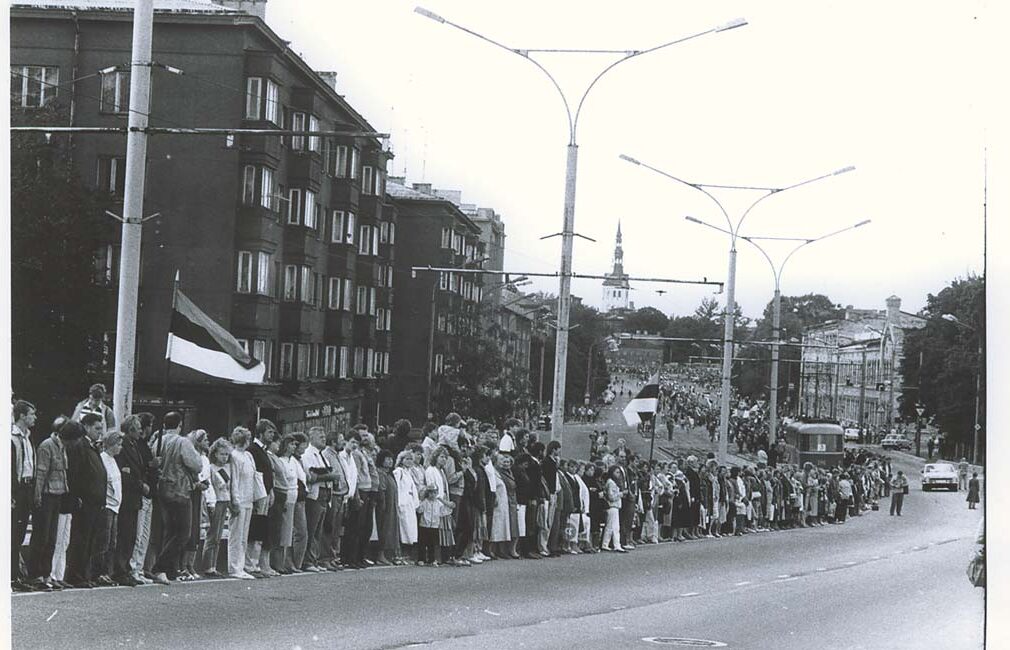
On August 23rd 1989 approximately two million people across Estonia, Latvia and Lithuania joined their hands forming a 670 km long human chain called the Baltic Way through the Baltic countries – reaching from Estonian capital Tallinn via Latvian capital Riga all the way to Lithuanian capital Vilnius -, thus demonstrating the unity in their efforts in regaining their freedom. The three Baltic States declared their re-independence soon after: Lithuania on March 11th 1990, Latvia on May 4th 1990 and Estonia on August 20th 1991.
The second Rock Summer festival took place at Tallinn Song Festival grounds on June 16th-18th 1989. Around 150 000 people participated in those three days in the second big rock concert with 30 artists performing, among those some Western musicians like The Jesus and Mary Chain from the UK and The Robert Cray Band from the US. Unlike concert audiences today – who’d be holding their phones to record the event – people were holding their national flags instead.

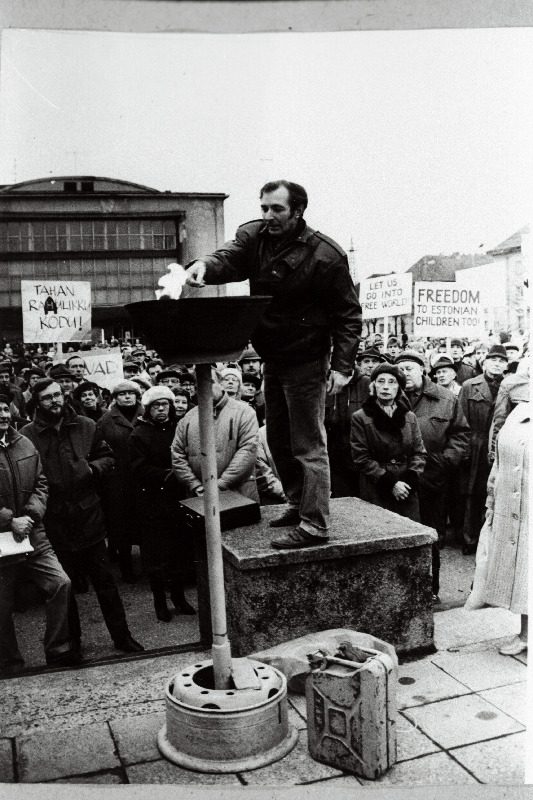
A protest meeting during a conference “Our Common Baltic Sea” that was organized by the Estonian Green Movement in 1989. This photo depicts a protester setting ablaze a can of water taken from a stream next to a Soviet military base at Ämari. The stream was apparently filled with military jet engine fuel as the torch goes up in big flames.
In the background signs of protest can be seen, including signs with text like “TAHAN RAHULIKKU KODU!”, meaning “I want a peaceful home!” in Estonian but also signs in English saying: “LET US GO INTO FREE WORLD,” and “FREEDOM TO ESTONIAN CHILDREN TOO!”.
Estonian Green Movement had been founded a year earlier, in 1988, to better coordinate the so-called Phosphorite Wars, a series of protests in Estonia that took place in the spring of 1987 and continued until 1988. It was sparked by the Soviet government’s plans to open new phosphorite mines in northeastern Estonia, which would have had a significant environmental impact on the region. The protests were a major turning point in Estonia’s struggle for independence, as they mobilized public opinion and demonstrated the growing discontent with Soviet rule.
According to the national census there were 1 565 662 people, including 963 269 Estonians (61,5 %) living in Estonia in the beginning of the year 1989. That is the largest population Estonia has ever had as there has been a sharp decline in births and immigration since then.
In 1989 there were 24 318 babies born across the country out of whom 15 701 or 65% were Estonians. The birth rate was 2,5 times higher than in 2024 when only 9690 babies were born in Estonia, although the percentage of Estonian babies is much higher today – 7045 or 73%. The population of Estonia currently stands at 1 369 995 according to the National Statistics Bureau (2025).

On November 9th the physical Iron Curtain separating Eastern Europe from the West – the Berlin Wall came tumbling down. One piece of the demolished wall that formerly stood near the Potsdamer Platz in Berlin can now be seen in front of Vabamu Museum on the corner of Toompea and Kaarli streets as it was donated to the city of Tallinn by the Senat of Berlin.
In December 1989 a revolution was sparked in Romania which resulted in overthrowing the long-term Romanian dictator, Nicolae Ceausescu.
“Born in 1989” is a project that unites six countries – Estonia, Poland, Germany, Romania, Hungary and Slovenia – to tell the stories of the historic events unravelling in each of the participating countries in the year of 1989. The project is supported by European Commission’s CERV-2024-CITIZENS-REM programme and according to their policy all participants have signed the Child Protection Policy: